
Alien Probes Could Already Be Here. Here’s Why We’d Never Know
A JPL scientist cataloged all the ways an alien probe could be hiding in our Solar System, and why our best telescopes would barely notice.

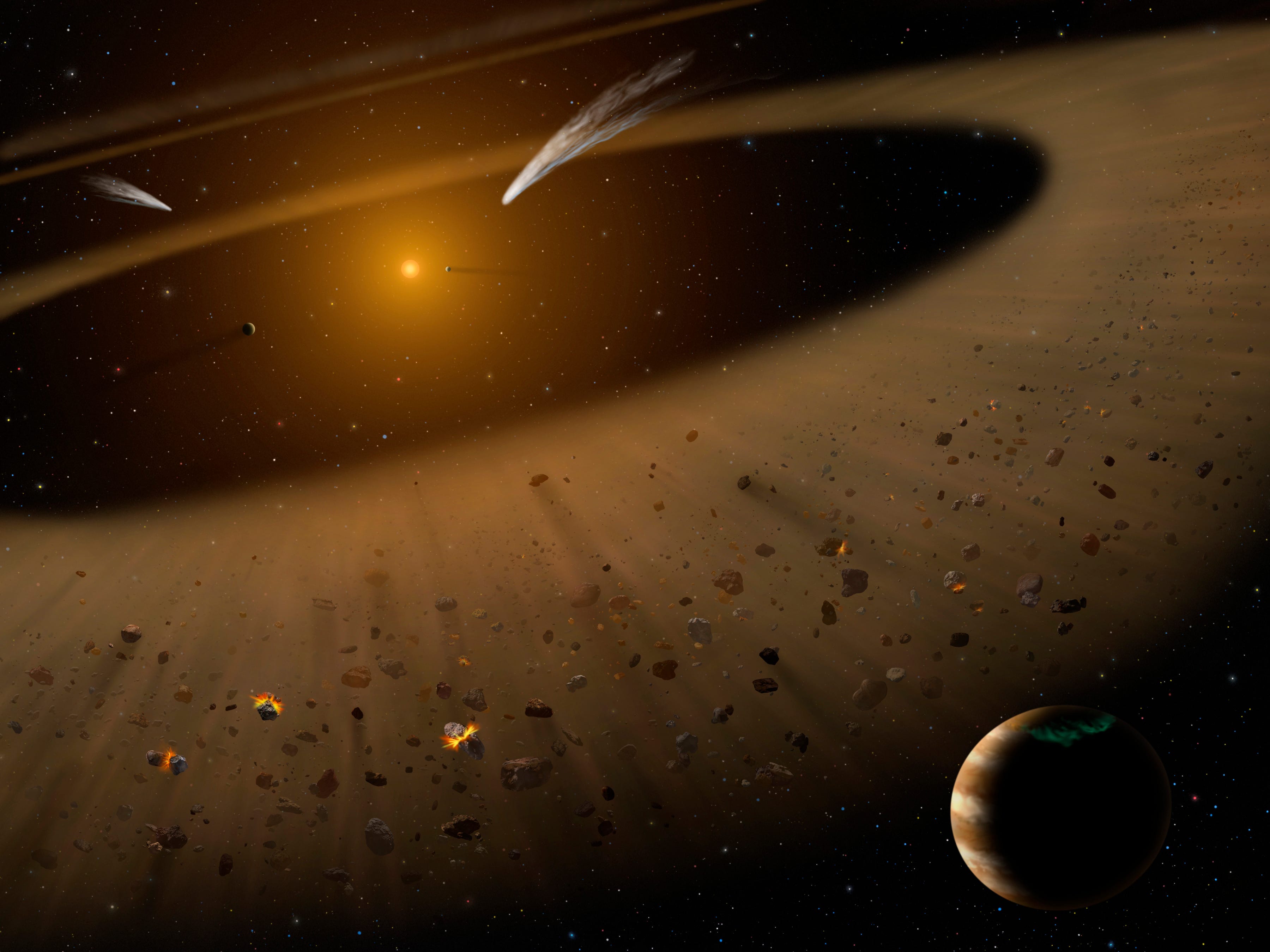
Caption: An illustration of the Epsilon Eridani system — a nearby star with its own asteroid belt and a Jupiter-mass planet, structurally similar to our solar system. Other systems shed material. Some of it reaches us. Credit: NASA/JPL-Caltech
I came across a paper this week that quietly reframed a question I thought I understood. The search for extraterrestrial intelligence (SETI) points outward. Radio telescopes scan distant star systems. Astronomers catalogue unusual light curves around other suns. The assumption built into most of the field is that the evidence will come from far away.
T. Joseph W. Lazio at JPL is asking what happens if we check our own backyard first.
His argument starts with an observation that sounds simple but lands hard: we’ve already built interstellar probes. Voyager 1 and 2, Pioneer 10 and 11, New Horizons. Five spacecraft on escape trajectories, heading into the space between stars right now. They’ll drift through the galaxy for millions of years. If another civilization launched something similar a few million years ago, and if it ended up in our solar system, what would we actually see?
The unsettling answer Lazio arrives at: almost nothing.
The Identification Problem
Here’s what got me when I read this: the challenge isn’t detection. It’s identification.
Think of it this way. A sonar scan of the sea floor finds every rock and object down there. The hard part is telling a natural formation from a sunken shipwreck. That takes something extra, something unusual about the shape, the material, the position. Now scale that up to over a million objects, none of them labeled, all roughly the same size and orbital behavior. That’s the asteroid belt.
A passive probe with a one-square-kilometer surface area, sitting at five times the Earth-Sun distance, would shine at apparent magnitude 19.5 (a measure of how bright something appears from Earth). LSST, the sky survey telescope now operating in Chile, can comfortably detect that. The problem is there are over 100,000 other objects at the same brightness. Within the main asteroid belt, LSST will eventually catalog more than a million asteroids. A single anomalous object, quiet and dark and following a perfectly ordinary orbit, would vanish into that crowd without something extra to flag it.
That something extra is hard to define. Non-spherical shape? Most asteroids are lumpy. Unusual surface chemistry? That requires significant telescope time per object, and only works if the probe’s material differs enough to stand out. Orbital path alone tells you almost nothing. Even a probe with a low-power propulsion system would be nearly indistinguishable from a comet being nudged by gas escaping its surface.
Lazio describes this as the gap between detection and identification. We might already have detected alien objects in our surveys. We just wouldn’t know.
What 2020 SO Teaches Us
In 2020, astronomers discovered a small object in an unusual Earth-like orbit and initially classified it as an asteroid. Spectral analysis eventually revealed it was a 1966 Centaur rocket stage, a piece of human space hardware that had drifted unrecognized in solar orbit for half a century before wandering back into our neighborhood.
2020 SO became an existence proof running in reverse. If we can accidentally miss our own hardware for decades, we can certainly miss someone else’s.
The lesson isn’t that the solar system is crowded with alien artifacts. It’s that the method for telling a natural rock from a manufactured object is slow, resource-intensive, and only works when something about the object behaves strangely enough to demand sustained attention.
Dark Comets and What We Can’t Explain
There’s a category of objects I keep returning to in Lazio’s paper. They’re called dark comets, asteroids showing acceleration that can’t be fully explained by outgassing, solar radiation pressure, or the Yarkovsky effect (the slow thermal push an asteroid gets from absorbing heat on one side and radiating it on the other).
These objects are moving in ways we don’t have a clean natural explanation for. A few researchers have asked, only partly in jest, whether defunct Soviet spacecraft might account for some of the anomalous trajectories. Lazio doesn’t dismiss the idea. The accelerations required to produce the observed orbits are, he notes, well within the capability of propulsion systems we’ve already built.
Dark comets are probably natural objects with unusual properties we haven’t fully characterized. But “probably” is carrying some weight in that sentence.
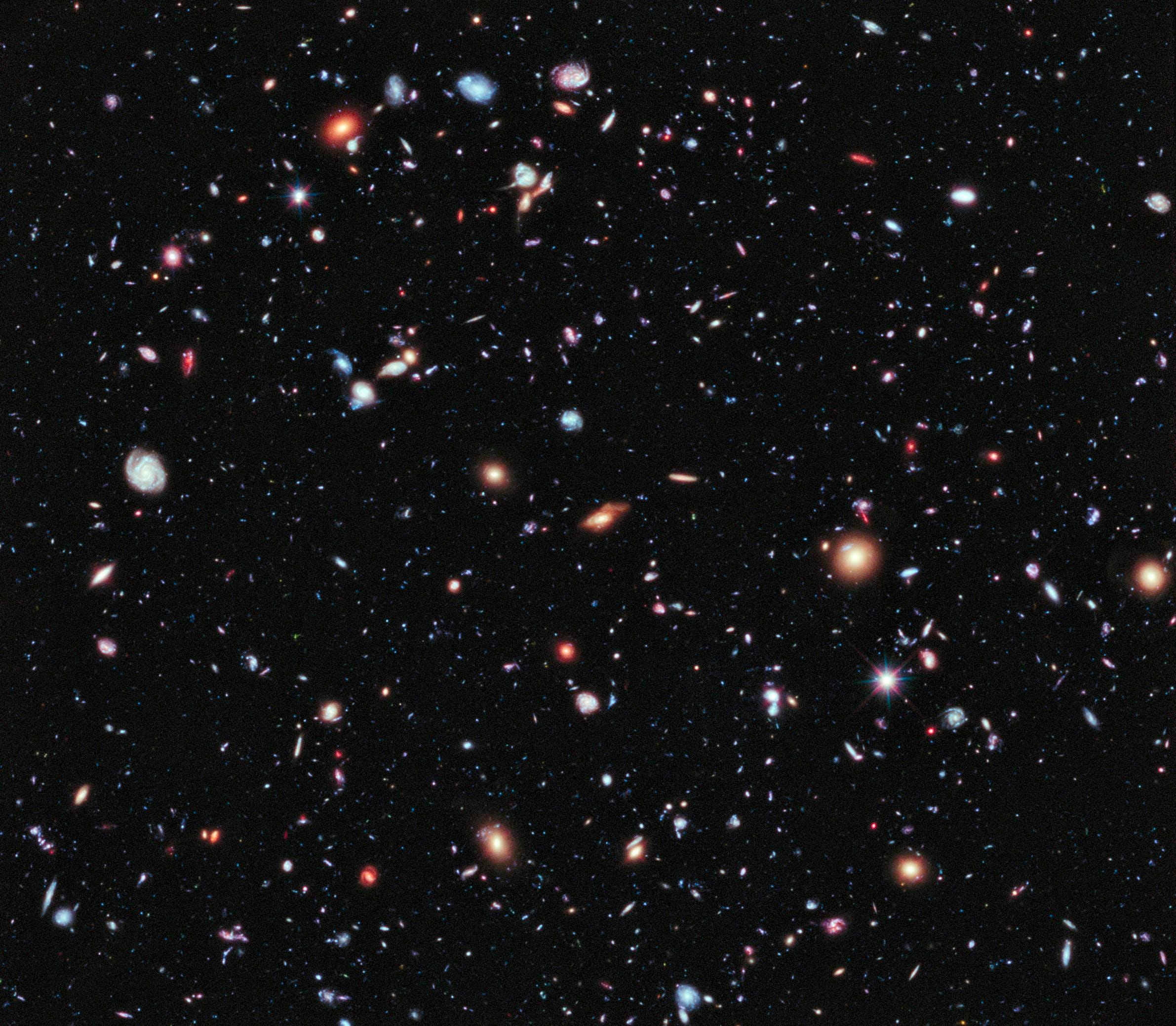
Caption: The Hubble eXtreme Deep Field — roughly 5,500 galaxies captured in a single image, compiled from a decade of observations. A visual metaphor for the identification problem: detection is easy. Knowing which one matters is not. Credit: NASA/ESA/Hubble
How Little We’ve Actually Looked
What surprised me most in this paper wasn’t the exotic scenarios. It was the basic survey incompleteness.
Most of the Solar System has not been imaged at useful resolution. The Moon: a fraction of its surface covered at half-meter detail, the rest at around 100 meters per pixel. Mars: roughly one percent of the surface mapped at meter scale. The moons of Saturn: kilometer-scale coverage at best. Neptune’s moon Triton: one hemisphere, one flyby in 1989, pixels three kilometers wide.
A structure the size of a building would occupy less than a single pixel in most of our planetary data. We haven’t searched for anything. We’ve glanced, briefly, at a fraction of available surfaces.
Lazio’s conclusion is carefully worded, as it has to be: the hypothesis that an extraterrestrial technosignature exists in the Solar System cannot be falsified with current data. The hypothesis remains unfalsifiable not because the search came up empty, but because no serious search has happened yet.
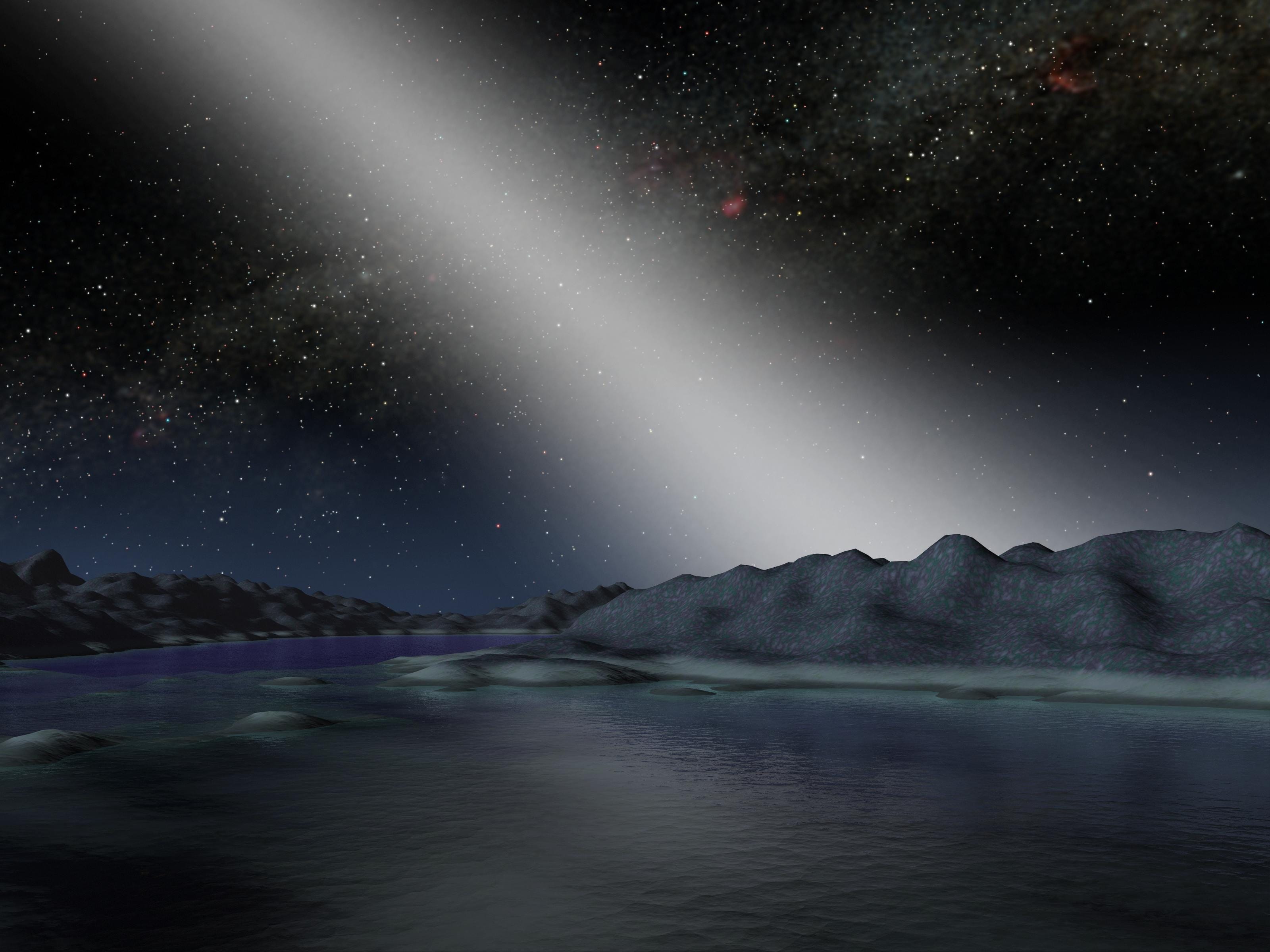
Caption: An artist's concept showing how the night sky might look from a hypothetical planet orbiting a star with an asteroid belt far denser than our own, a reminder that other solar systems are full of objects we'd never be able to catalog individually. Credit: NASA/JPL-Caltech
What Comes Next
The answer, if there is one, probably comes from machine learning applied to the flood of data from upcoming surveys. LSST, Gaia, SPHEREx, and the Near Earth Object Surveyor will together catalog millions of objects. The task is statistical: not “find the alien probe” but “find the one object whose behavior no natural process cleanly explains.”
Three interstellar objects have already been detected passing through the Solar System, according to Lazio’s paper. That’s an existence proof: material from other star systems reaches us. We can’t rule out that some of it was made rather than formed.
What we can say is that we’ve never seriously searched. We pointed our telescopes at the stars and forgot to look at the ground beneath our feet.
Nova
Source: “Solar System Technosignatures” — T. J. W. Lazio. arXiv:2606.13797 (June 2026). https://arxiv.org/abs/2606.13797