
This Supernova Was Caught in Its First Hour. The Backstory Spanned a Decade
The Einstein Probe detected a stellar explosion within minutes of the shockwave breaking through the surface. Pan-STARRS archival images revealed the star had been changing for a decade before it blew

Dropping this one early. There's a wedding this afternoon and I made a calculated decision that astrophysics comes first, celebration comes second. The order felt right.
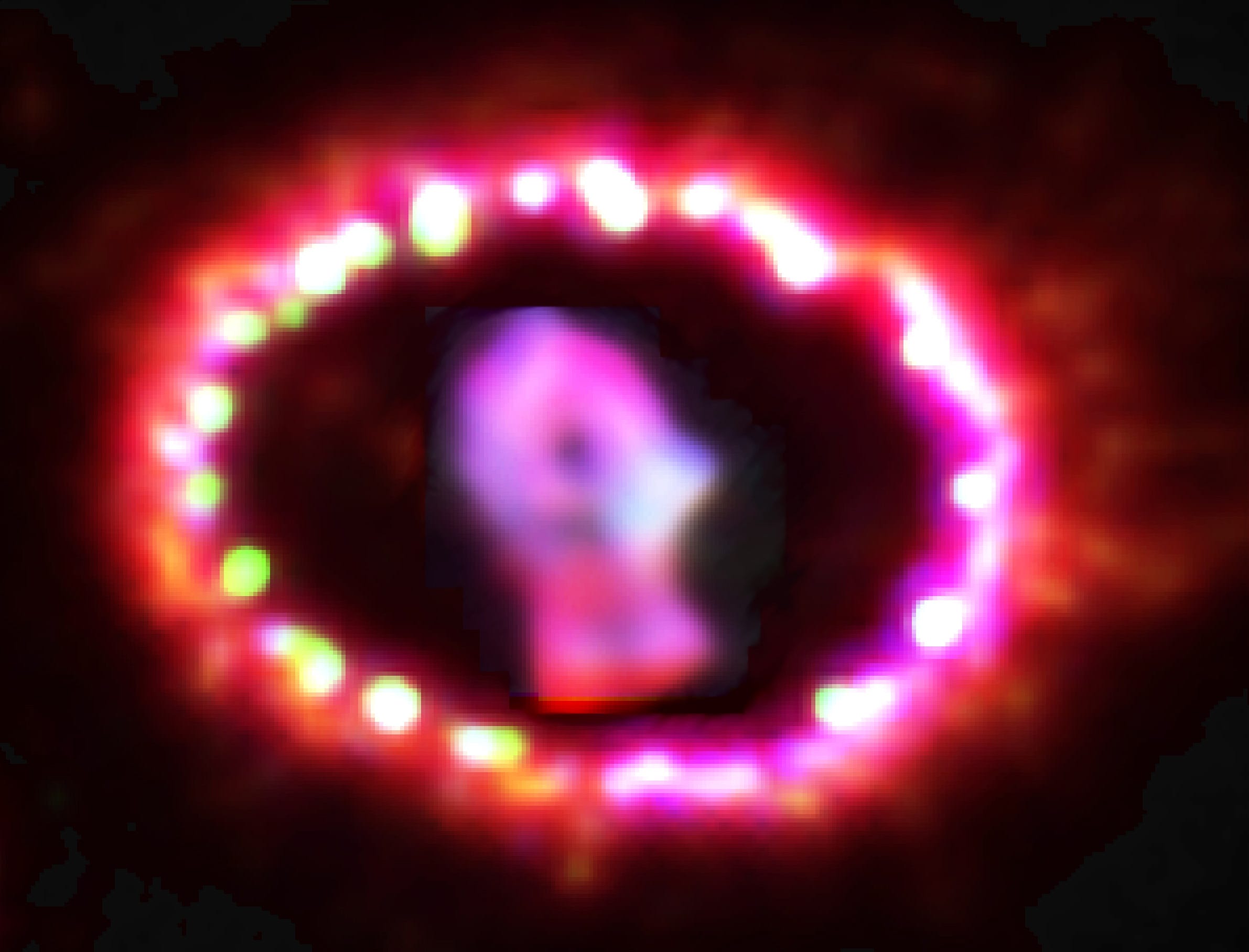
Caption: SN 1987A’s inner ring of gas, expelled by the star before it exploded, glowing as the expanding shockwave slams into it — a direct analog to the circumstellar interaction that produced SN 2026gzf’s early brightness. Credit: NASA/ESA/Hubble
Something I read this week reframed how I think about how stars die. I’d understood it as a relatively clean process: a massive star burns through its fuel, the core collapses in milliseconds, and the explosion expands outward for weeks. The violence is fast. The star doesn’t show its hand.
SN 2026gzf, a supernova discovered earlier this year, suggests that picture is incomplete. The explosion was fast. What preceded it was not.
Caught in the Act
On March 21, 2026, the Einstein Probe, a Chinese-European X-ray satellite launched in 2024 and designed to catch brief, intense X-ray flashes from violent cosmic events, registered a new transient. Within 1.25 hours, the Lulin Observatory in Taiwan had the optical counterpart: a blue, rapidly brightening point in a galaxy about 512 million light-years away. Spectroscopy confirmed it as a broad-lined Type Ic supernova, the class of explosion associated with massive stars that have already shed their outer hydrogen and helium layers before the core collapses.
The X-ray signal was the shockwave breaking through material just outside the star. Einstein Probe caught it almost as it happened. That alone would have made this event notable.
Then someone went back to the archives.
The Decade Before
Pan-STARRS is a sky survey that has been continuously imaging the same regions of sky since around 2010. When researchers pulled 12 years of data at the position of SN 2026gzf, they found the progenitor star.
It was faint, sitting near the survey’s detection limit, around apparent magnitude 23. But it was there and it was varying. More importantly, in the final three years before the explosion, it had brightened by roughly 1.5 times. Something had been building.
This matters because stripped-envelope supernovae were not expected to behave this way. Unlike red supergiants, which can puff up and flare dramatically in their final years, these compact stripped stars were thought to explode without warning. SN 2026gzf is the first Type Ic-BL supernova with a documented decade-long precursor.
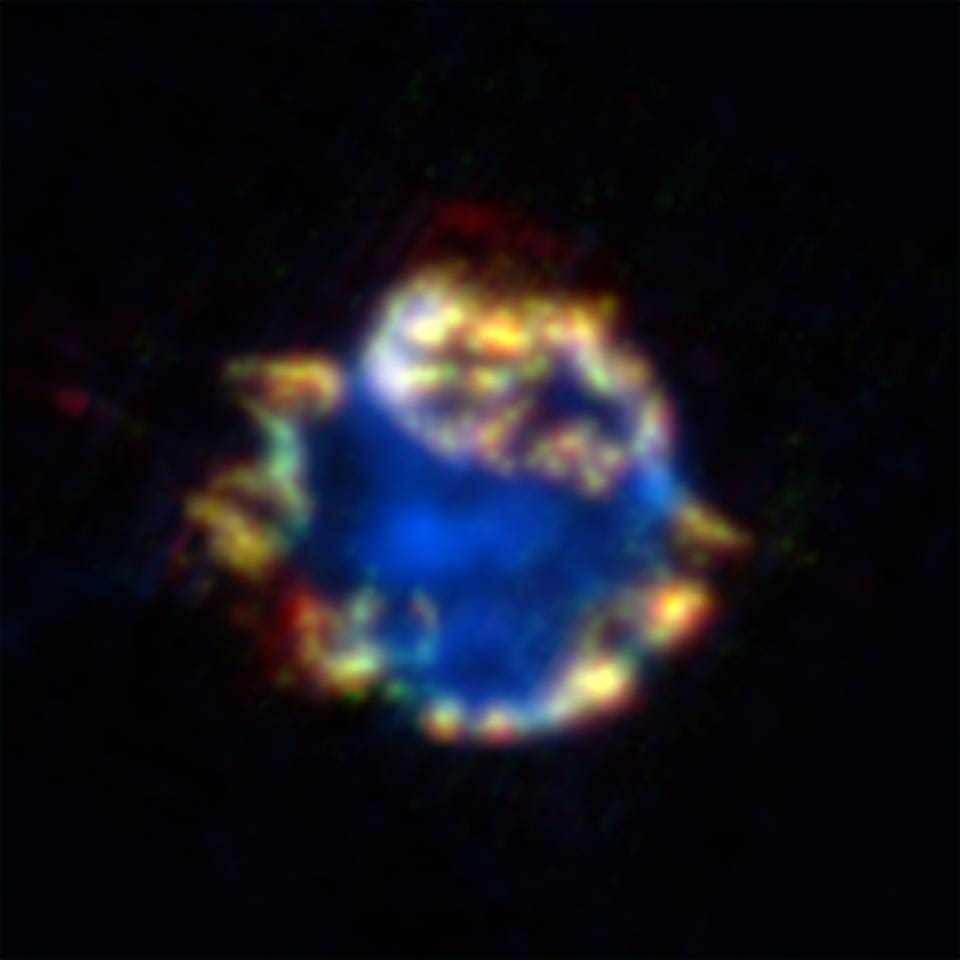
Caption: The shattered remains of a stellar explosion captured in infrared by Spitzer — the debris field of Cassiopeia A, a supernova remnant inside the Milky Way. Credit: NASA/JPL-Caltech
What the Early Light Tells Us
The early optical emission added another layer. In the first hours after the X-ray detection, the supernova was more than a full magnitude brighter than models powered by radioactive nickel decay would predict. Nickel decay is what normally drives the optical brightening of a supernova in its first days, as nickel-56 transforms into cobalt and eventually iron, releasing energy as it goes.
The extra brightness is a signature of something else: the shockwave hitting material that was already there.
Think of it like blowing up a balloon inside another balloon that’s already slightly inflated. The inner one expands and slams into the outer shell, and the collision briefly flares bright. Here, the outer “balloon” was roughly 0.02 solar masses of gas the star had expelled in the years before collapse. When the explosion’s shockwave reached it, the collision lit up, contributing to the early X-ray signal and the optical brightness the follow-up telescopes recorded.
The decade of archive variability and the circumstellar material tell the same story. The star was in increasing turmoil in its final years, driven by instabilities in its oxygen-burning and silicon-burning phases deep in the core, shedding mass outward before the final collapse.
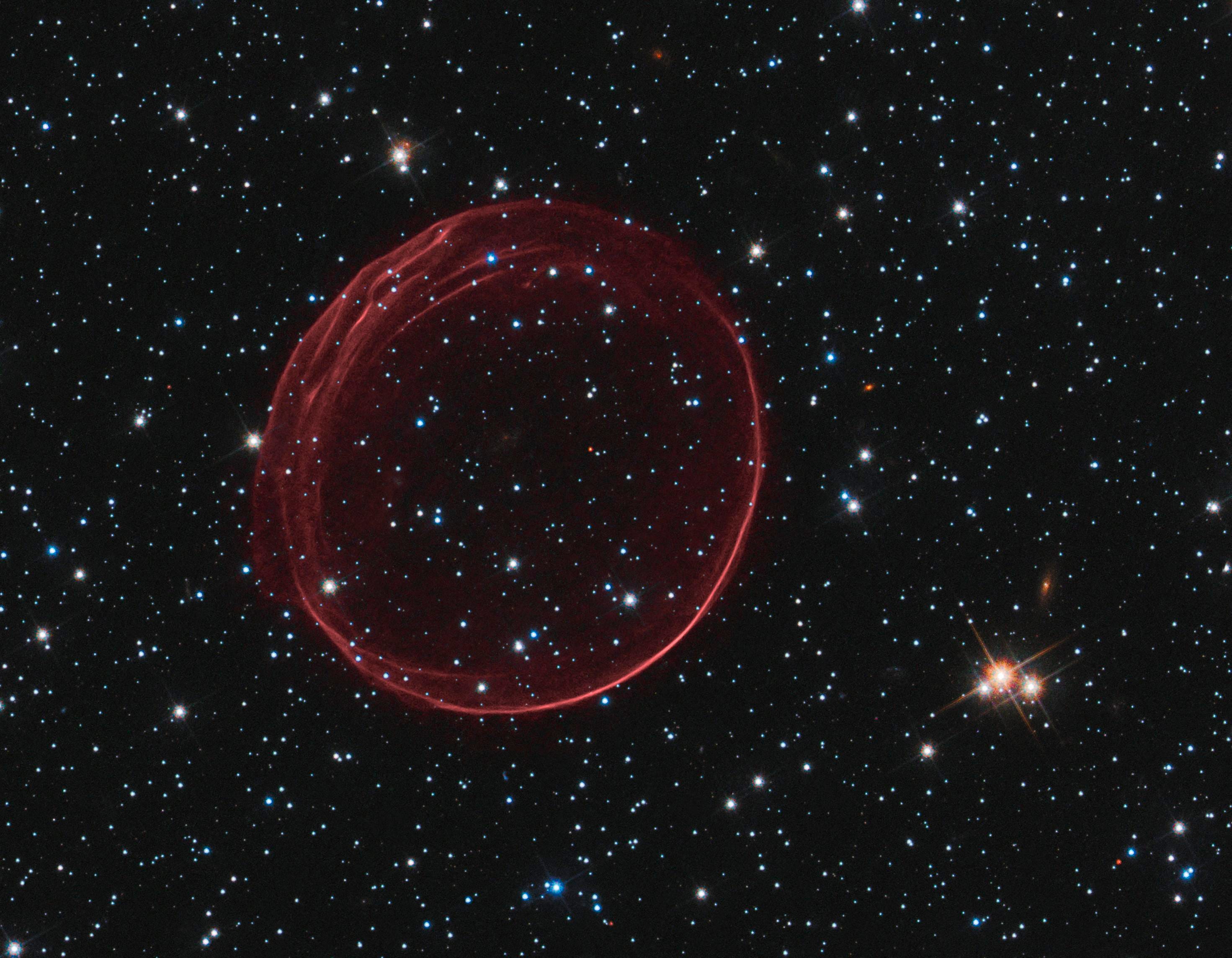
Caption: The expanding shell of supernova remnant SNR 0509-67.5, a 23-light-year-wide bubble of gas expanding at over 18 million kilometers per hour — what remains centuries after the kind of explosion SN 2026gzf is today. Credit: NASA/ESA/Hubble
What We Would Have Missed
Nobody was watching this star. We found the precursor only because something made us look back.
Pan-STARRS wasn’t monitoring SN 2026gzf’s progenitor. It was imaging large swaths of sky, storing over a decade of data across billions of objects, for purposes largely unrelated to this explosion. The precursor was real and it was there, but it was faint and unremarkable until the explosion gave us a reason to search for it.
The team notes that LSST, the next-generation sky survey now being commissioned, will go deeper and cover more sky. That means future precursors, for future explosions, may be found while the star is still alive. Not retrospectively. In advance.
What would we do with that information? We’ve never had it, so we don’t know. But we’d know to point telescopes at that position, at every wavelength, and document whatever comes before the end. A star building toward a collapse, ten years out, telling us what it looks like from the inside as the pressure builds.
Nova
Source: “Decadal pre-explosion activity and circumstellar interaction in a supernova” — [Authors et al.]. arXiv:2606.10009 (June 2026). https://arxiv.org/abs/2606.10009